Viser opslag med etiketten Sustainability. Vis alle opslag

22. jul. 2016

Sustainability

In July 2016 Champagne Tange-Gerard obtained the status of sustainable winegrower.

This has implications for the way we work in the company.

In the vineyards, sustainability covers these areas:

You and the vineyards: Thumbs up for this attitude


Many good people has come to work with us. They ask smart questions that make us all learn more. Please click this FAQ to know more as well.


Sustainability sitemap: Overview of all sustainability pages

Home


21. jul. 2016

Sustainability : The spreading of fertilizers

We spread the organic fertilizers in late winter.

Organic fertilizers work much slower in the soil than conventional ones. They deteriorate much slower which means that the elements will be available to the plant maybe only several months after spraying. The idea is to keep the levels in the soil and make sure nutriments are available in the period of growth

Frozen rather than muddy
For us, it is practical to spread the fertilizers in the winter because the ground is likely to be dry and hard.

As we plough the vineyards, the rows may otherwise be quite muddy.

Our little machine moves forward due to its caterpillar tracks so they will move anyway. But it is physically harder to manoeuvre it.

Nourish the soil
The idea of fertilizers is not to nourish the plant directly.

Instead we supply elements and minerals that will nourish the soil based on our soil analysis.

When the soil is healthy and sufficiently rich, it constitutes the best possible environment for the vines to remain strong and vigorous as they grow.

Several decades ago pulverized city garbage (known as gadoues, composts urbains) was spread in vineyards all over Champagne because it was thought to nourish the environment. This has left a heritage of tiny plastic pieces in the rows. Obviously, this practice has been banned years ago, but as plastic decomposits slowly, the traces stay.

Grind and spread
We use a machine, specially conceived for the vineyards, to spread the fertilizers.

For the purpose of this job, we equip the machine (le chenillard) with a spinning sprayer. The funnel is filled with the fertilizers, and as we move the machine forward, the pellets are sprayed over 4 rows.

A maximum average of 50 kilos per hectare of nitrogen is allowed within the regulations of sustainable winegrowing. However, we tend to put less.

Return Sustainability main page or
How to nourish the soils


Sustainability : Frequently Asked Questions (FAQ)


Q: You are sustainable, but why are you not fully organic?
A: We'd like to. Basically it is because one task that makes it currently impossible to be 100% organic, which is our sprays of fungicides. We are not equipped to do it ourselves and the company that works for us does not have an organic option. Once they do, we will probably go for it.


Return Sustainability main page


Sustainability : How to work in the growth period


A healthy vine is a very vigorous plant.

However, if it grows too many stems with too many leaves, it may damage the quality of the grapes.

Therefore we aim at controlling the vine and keep its growth at a strict minimum.

The removal of buds (ébourgeonnage)
Only buds that grow on branches from last year will grow grapes. These one year old branches are the young wood left at the pruning.

However buds may grow all over the plant: At the foot and on older branches and they will either not provide fruit or only very few and very small grapes. But they will grow into stems as big as the fertile ones. Thus the plant spends energy for nothing, which is why we remove these buds manually.

The buds are very pink just before they burst, thus they are easy to spot.

They are very soft and easy to remove with your hands.

Around this time we unhook the middle wire of the trellis to put it on the ground. This allows the buds to grow freely. In some vineyards we have a double wire at the foot of the plant to manage low stems, this wire is unhooked and put on the ground as well.


Return Sustainability main page or How to work the vines


The removal of stems (épamprage)
The Chardonnays come into leaf a few days before the Pinots. Still we may only arrive in some vineyards after some days of growth.

Thus some buds may have time to develop into small stems, before we come to remove them.

However, the proces is the same as for the buds, and the young stems are still very soft and easy to pull off.

Buds continue to develop and we continue to remove whatever grows on old wood.

It is still very easy to separate old wood from one-year-old wood. Once the stems are longes and the leaves bigger, it will take more time to check.


Return Sustainability main page or How to work the vines


1st lift of wires (relevage)
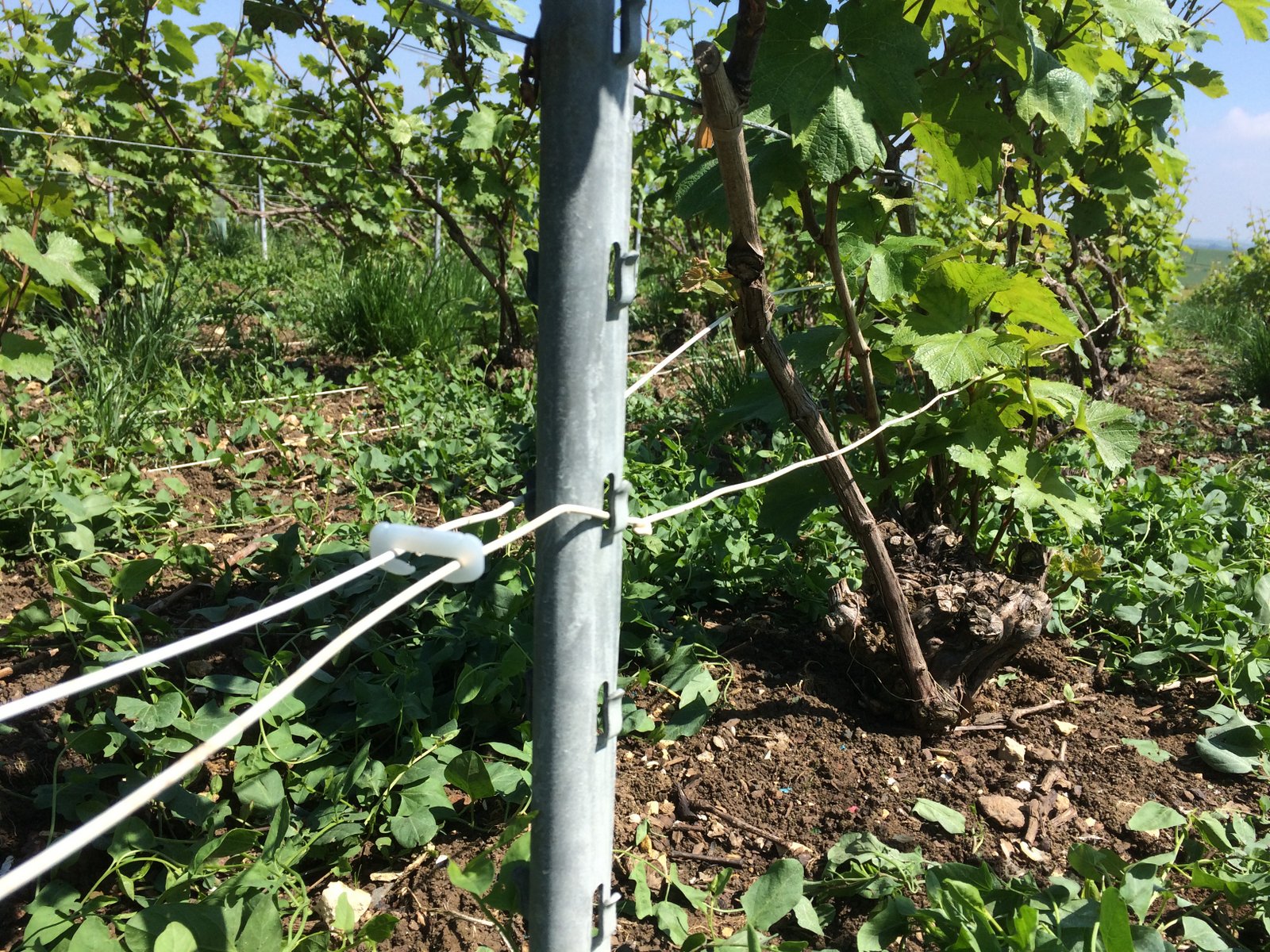
The trellis carries three wires in different heights.

The middle wire is also double, and it is used to control the stems.

As the young stems reach a sufficient length, this middle wire will be lifted and placed in the lower hook on each of the posts.

The operation will lift up a number of stems to place them between the double wire with their tip pointing upwards.

However many stems will not have grown sufficiently to stay between the wires, and they will be put back manually later.

At you move up the row of vines, you will place one wooden agraffe before each post. This helps to keep the double wires together and a miximum of stems to remain in between.

You may still find new buds growing on old wood. Please remove them, they will develop into stems with no grapes and eventually the amount of leaves will be too overvældende for the plant to feed. On top of that, a too dense hedge may allow fungus to install themselves which is one of the major causes of disease.

Why not as you are passing though have a look at your feet to meet the weeds?


Return Sustainability main page or How to work the vines


2nd lift of wires (relevage)
The growth of the plants at this time is very vigorous. Sometimes the stems have grown visibly longer from day to day.

A few weeks later, the double wire will be lifted to the second hook or similar heigth if the hook is missing.

Stems that were not caught by the wires at the first lifting, may have grown long enough now, and they will be put in place manually by gently manipulating the stem under the wire.

It is a delicate job, since they are still soft and break easily, especially after rain.

At this moment, you place a second agraffe in the middle between two posts. It is important that you separate the two plants correctly.

This agraffe looks like white plastic but in fact, it is made of bio starch that will disintegrate completely in less than a year.

New buds still develop, and when you see their pink colour pointing out at old wood, you continue to remove them.

All through the growth season, we aim at keeping the size of the plant at a strict minimum. The same goes for the weeds at your feet.


Return Sustainability main page or How to work the vines


Trellissing the vines (palissage)
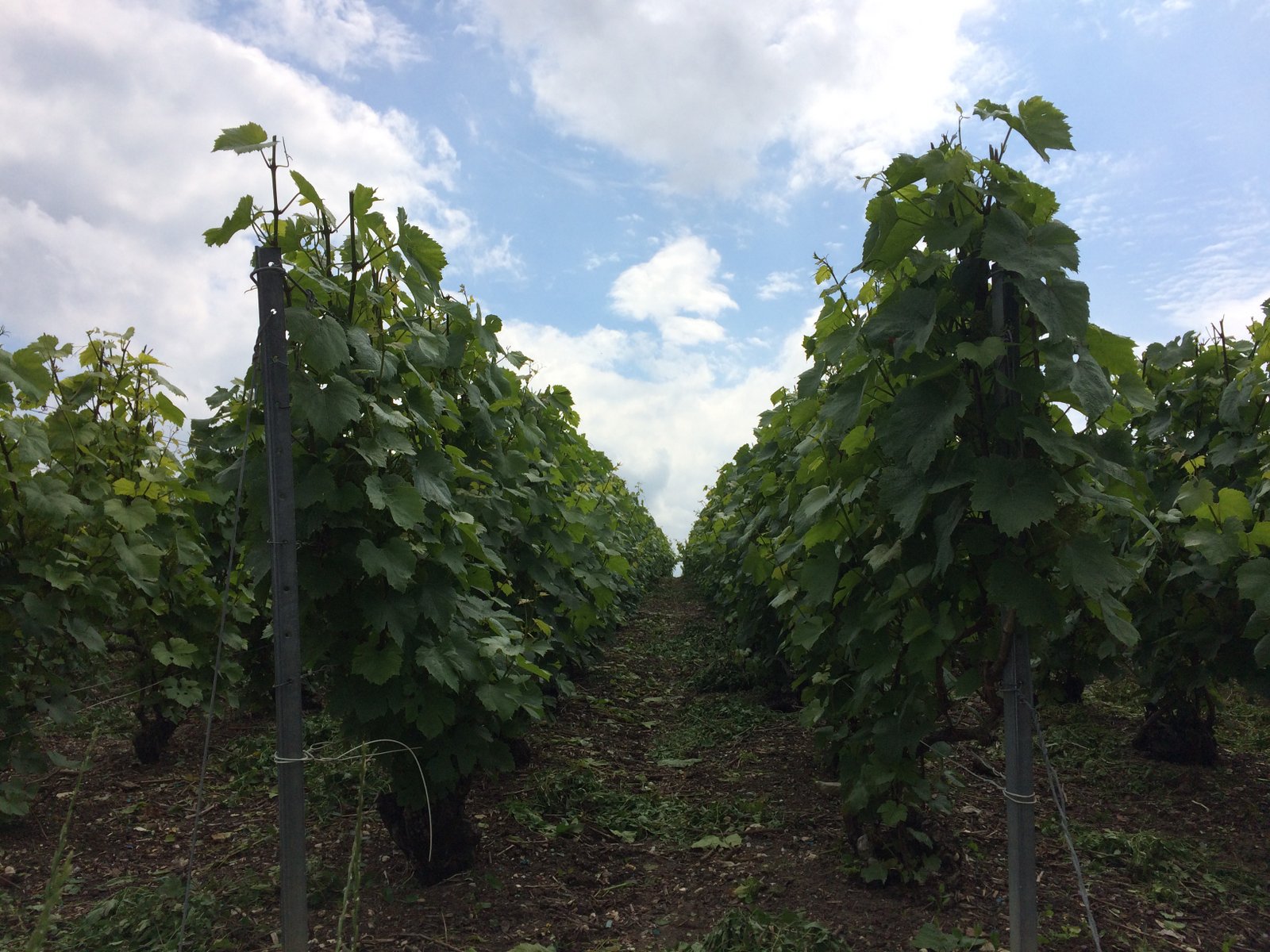
Once the second lifting is through we usually move straight on with the trellissing. When this is finalized, the vineyards will look like rows of green hedges, in order, rather than the anarchy vines tend to create naturally.

At this time we want all the stems to be in place between the double wire.

Usually the important stems - those with the future grapes, that are visible by now - will be long enough to remain between the wires once they have been put back.

As we collect the stems, we are careful to place them at the wire so they point upwards and never sidewards. This is done to avoid that several stems cross each other, which may create a wall of leaves that will be too dense, making it harder for the wind to dry out humidity : Always a possible carrier of mycotic spores that spread fungus diseases.

Once the stems are in place, we spend time to separate them nicely along the double wire.

Two more biostarch agraffes are put, adding the total up to four. Now each plant is nicely seperated from its neighbour. When the stems are placed correctly, it will allow the grapes to catch a maximum of sun and keep the density of the leaves at a minimum.

We work the soils with the plough to remove weeds.

However, sometimes we may need a hand the old-fashioned manual way with these weeds.

Several passsages may be necessary to finish the trellissing nicely. Usually, it is a job of six weeks to deal with three hectares of vines.


Return Sustainability main page or How to work the vines


So we have done other things as we waited for better times, better days.

Trimming (cisaillage)
The vines will have their tops cut once per week during the summer. This is done with scissors installed at the tractor.

Once the tops of the stems have been cut, they will grow from the sides.

However the machine can not reach the lower part of the hedge, so we manage this task manually with the big scissors used to remove bigger branches.

This work will keep the amount of sterile stems as well as the density of the leaves at a minimum.

Need we remind you? We still look out for these weeds.


Return Sustainability main page or How to work the vines

Sustainability : How to nourish the soils and the vines

We add organic fertilizers to maintain the necessary level of minerals and organic matter in the soils of the vineyards.

This is measured and spread very accurately to avoid adding too much which may otherwise contaminate the subsoil water or evaporate as greenhouse gas.

We carry out this job once per year, preferably late winter.


The work is based on a soil analysis. Please click to know more about the planning of fertilizers


We spread the fertilizers with the help of a small machine following several principles. Please click to know more about the spreading of fertilizers


Return Sustainability main page

Sustainability : Sitemap


Your attitude...........Thumbs up for this attitude

Chapter 1..........How to work in the vines
Chapter 2..........How to handle waste
Chapter 3..........How to protect sustainably

Chapter 4..........How to nourish the soils
Chapter 5..........How to maintain the soils
Chapter 6..........How to apply protection
Chapter 7..........How to organize the vineyard
Chapter 8..........How to operate globally


Frequently Asked Questions : FAQ


Sustainability main page

Sustainability : Thumbs up for your attitude


A vineyard is a fragile ecosystem.

We care about it. And your attitude makes a difference.

  • Thin gloves may break. If it happens, don't leave the pieces behind you some where. Please bring them back to the farm to throw them correctly there
  • Some of us smoke. The filters don't disintegrate fast. Please don't leave them behind you in the vines. Bring a bin bag yourself
  • Chewing gum may not be handy in your pocket. It is not handy in the vineyards either. Please bring a bin bag yourself to throw it correctly
  • We all need to pee now and then. But paper tissues actually don't disintegrate that fast. Please store your paper in a bin bag
  • We try to plan things well, but even so it still may not be perfect. Many from our staff have experiences from other jobs, that can be useful for us. Please don't hesitate to share, whenever you have an idea


Return Sustainability main page

Sustainability : Meet the weeds


We want to stop herbicides.

Instead we plough with the tractor to remove weeds.

But we also weed manually when needed.

We use a hoe and sometimes our hands.

These are the weeds we try to limit.


The bindweeds climb in the vines, thus makes it possible for humidity to have an easier access thus supporting the risk of fungus disease.

This plant has very long roots, and once you break a root, it will spread even more underground.

The thistle spreads a lot as well. The main problem is the thorns that are quite unpleasant as we work, sometimes seated, in the rows at the time of harvest.


Return to the growth period or How to work the vines or Sustainability main page or

Sustainability : Green work Wiki

Please participate: Leave a comment below or send a mail. It will be updated fast.

So far, here's some advice.

The grapeharvest
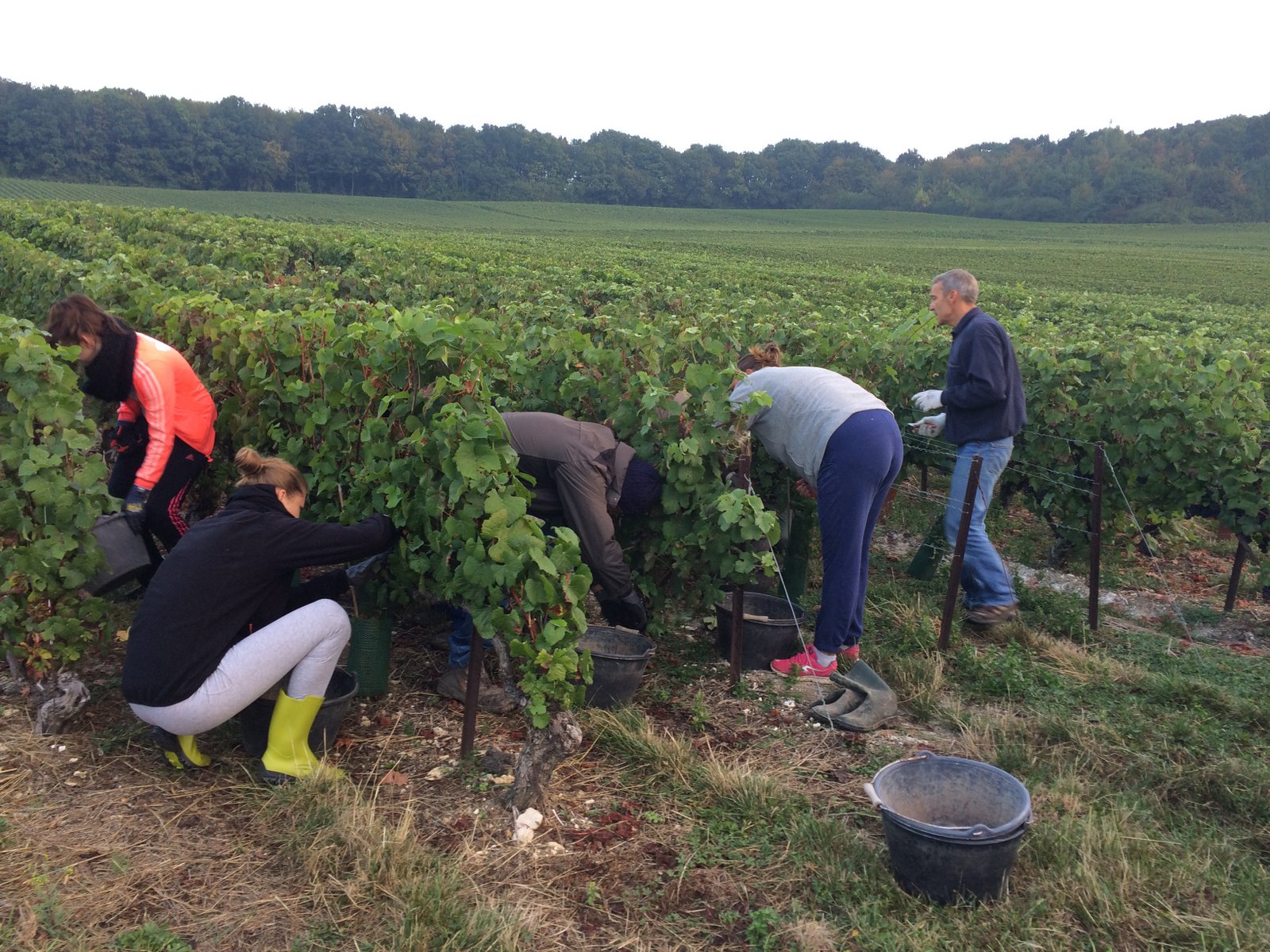
At Champagne Tange-Gerard, we mainly hire you to pick grapes.

If you join in, there are few things, you may find useful to know.

The vines are kept a bit taller than 1,2 meters. This is rather low, when you are an adult, and on top of that, most of the grapes are situated below that heigth anyway.

Especially the green Chardonnays are not that easy to spot under the leaves. You may have to search a bit to find them all.

Change position
This means that you will often work in uncomfortable positions. With your back bent, on your knees or squat down.

It helps to change position regularly.

Which brings the next advice forward.

Knee pads
Many bring their own protection for the knees, and it is quite useful, because it enables you to move faster without hurting your knees.


Work mates
Each picker deals with one side of a row of vines.

This means that you may work close to a collegue who deals with the neighbouring row. Eventually you will take turns naturally in order not to be in the way of the other. Often the two teams don't work in excactly the same speed which solves the being in each others way in a natural way.

You work with the guy who deals with the other side of the row.

Please be careful not to cut each other.

If you notice that your collegue forgets the grapes at the bottom of the plant, you may say so, nicely, or cut these grapes yourself. What matters is that all healthy grapes are picked.


Please participate: Leave a comment below or send a mail. It will be updated fast.


Return Sustainability main page or How to work the vines

Sustainability : How to operate globally

UNDER CONSTRUCTION

Sustainability : How to adapt and organize the vineyards

UNDER CONSTRUCTION

Sustainability : How to apply products of protection

UNDER CONSTRUCTION

Sustainability : How to maintain the soils

UNDER CONSTRUCTION

Sustainability : How to work in the winter period


The pruning
Each vine is an individual. When you prune the plant, you must make sure to respect the rules of pruning as well as the vigour and growth of each plant.

Most plants are in a good healthy state, which means you prune them normally according to the reglementation (In French).

The vigour of some plants is not strong. We prune them harder than the reglementation requires to enable them to restore their vigour by producing less or no grapes. This is done by reducing the number of fertile buds on weak vines.

No vines are pruned less than the requirements.

The binding
Once we finish the pruning, the branches of the vines are attached to the wires.

The stems of last year have now hardened into branches. However they are not yet shaped.

Binding them to the low wire of the trellis will create the typical shape of the vine. The Chardonnays are pruned in the Chablis-manner which leaves a typical example three fingers of different length depending on their age. The Pinots are pruned in either the Cordon-style or the Vallée de la Marne-style, both of which requires a bow that will be attached along the low wire.

The operation is done with a tool that is either manual or a rechargeable machine that you carry in your hand, battery on your back.

If the string/cord used is not broken up naturally or at harvesttime, we will break it at the next pruning season. Once on the floor, the string is biodegradable.

The wooden parts
The pruning of the vines leaves you with pieces of wood to deal with.

You can either burn it or crush it with your tractor to add organic matter that will nourish the soils.

We opt for the burning to avoid spreading disease as for instance esca, that is contagious and kills the plants fast or slow.

The wood is separated in two groups : one year old branches and stems of several years.

The branches are burnt in the vineyards.

The thicker stems are collected and brought back to the farm to be used as firefood in fireplaces or BBQ's.

This burning omits CO 2, however so does the crushing by the tractor. The preferred practice in sustainability is to make use of the energy created by burning the wood.


Return Sustainability main page or How to work the vines


Sustainability : How to protect vineyards in a sustainable way

UNDER CONSTRUCTION

Sustainability : How to handle waste

UNDER CONSTRUCTION

Sustainability : How to work in the vines


The aim of our work is to help the vines grow as strong as possible.

During the growth season - usually from mid April to late September - consistent dealing with the amount of leaves, will help the grapes remain healthy. Please click to know more about our work in the growth period.

Experiences or thoughts? Please share them with us in this green work Wiki.


Only strong and healthy plants provide grapes of great quality year after year. This is why we prune the plants in the winter. Please click to know more about our work in the winter period.

Experiences or thoughts? Please share them with us in this winter work Wiki.


Return Sustainability main page

21. jun. 2016

Sustainability : The planning of the fertilizers

We regularly analyze the soils in our different plots.

These cover three hectares close to the villages of Soulieres and Loisy-en-Brie in the department of la Marne.

We classify them in seven different units and analyze one per year.

The objective of the analysis may be to measure for instance the general state of the plot but it may also cover a more specific issue somewhere in a plot.

The plots:

The sampling of the plot
We collect the samples of soils with the manual drill in a depth of up to 30 centimeters.

A minimum of 10 samples per hectare are demanded. We usually do more, but the amount will depend on the objective of the analysis.

The samples are mixed thoroughly in a basket as only a minor quantity will be sent off to the lab.


The soil analysis
At the lab, the physical and the chemical composition of the soil is analyzed.

Based on this, the lab makes a diagnosis of the status of the plot regarding elements, organic material and important ratios like the carbon/nitrogen to confirm that the levels of nitrogen and of organic matter brought to the plot stay within a correct range in order to optimize liberalization of nutriments.

The fertilization strategy
The lab will suggest a strategy for the fertilization based on its diagnosis.

However, we also use our experiences in the plots as input for decisions. For instance, a lab analysis may point at a lack of manganese or potassium in a plot. If the colours of the leaves don't show signs of this in the plot analyzed, we will keep an eye on it but not change our fertilization strategy.

We use organic fertilizers exclusively (guano (Wikipedia)). The choice will be the product that fits the suggestions of the lab combined with our own observations.


Return Sustainability main page or
How to nourish the soils


Sustainability : Winter work wiki

Please participate: Leave a comment below or send a mail. It will be updated fast.

So far, here's some advice.

The grapeharvest
At Champagne Tange-Gerard, we mainly hire you to pick grapes.

If you join in, there are few things, you may find useful to know.

The vines are kept a bit taller than 1,2 meters. This is rather low, when you are an adult, and on top of that, most of the grapes are situated below that heigth anyway.

Especially the green Chardonnays are not that easy to spot under the leaves. You may have to search a bit to find them all.

Change position
This means that you will often work in uncomfortable positions. With your back bent, on your knees or squat down.

It helps to change position regularly.

Which brings the next advice forward.

Knee pads
Many bring their own protection for the knees, and it is quite useful, because it enables you to move faster without hurting your knees.


Work mates
Each picker deals with one side of a row of vines.

This means that you may work close to a collegue who deals with the neighbouring row. Eventually you will take turns naturally in order not to be in the way of the other. Often the two teams don't work in excactly the same speed which solves the being in each others way in a natural way.

You work with the guy who deals with the other side of the row.

Please be careful not to cut each other.

If you notice that your collegue forgets the grapes at the bottom of the plant, you may say so, nicely, or cut these grapes yourself. What matters is that all healthy grapes are picked.


Please participate: Leave a comment below or send a mail. It will be updated fast.


Return Sustainability main page or How to work the vines