Viser opslag med etiketten Terroir. Vis alle opslag

21. jul. 2016

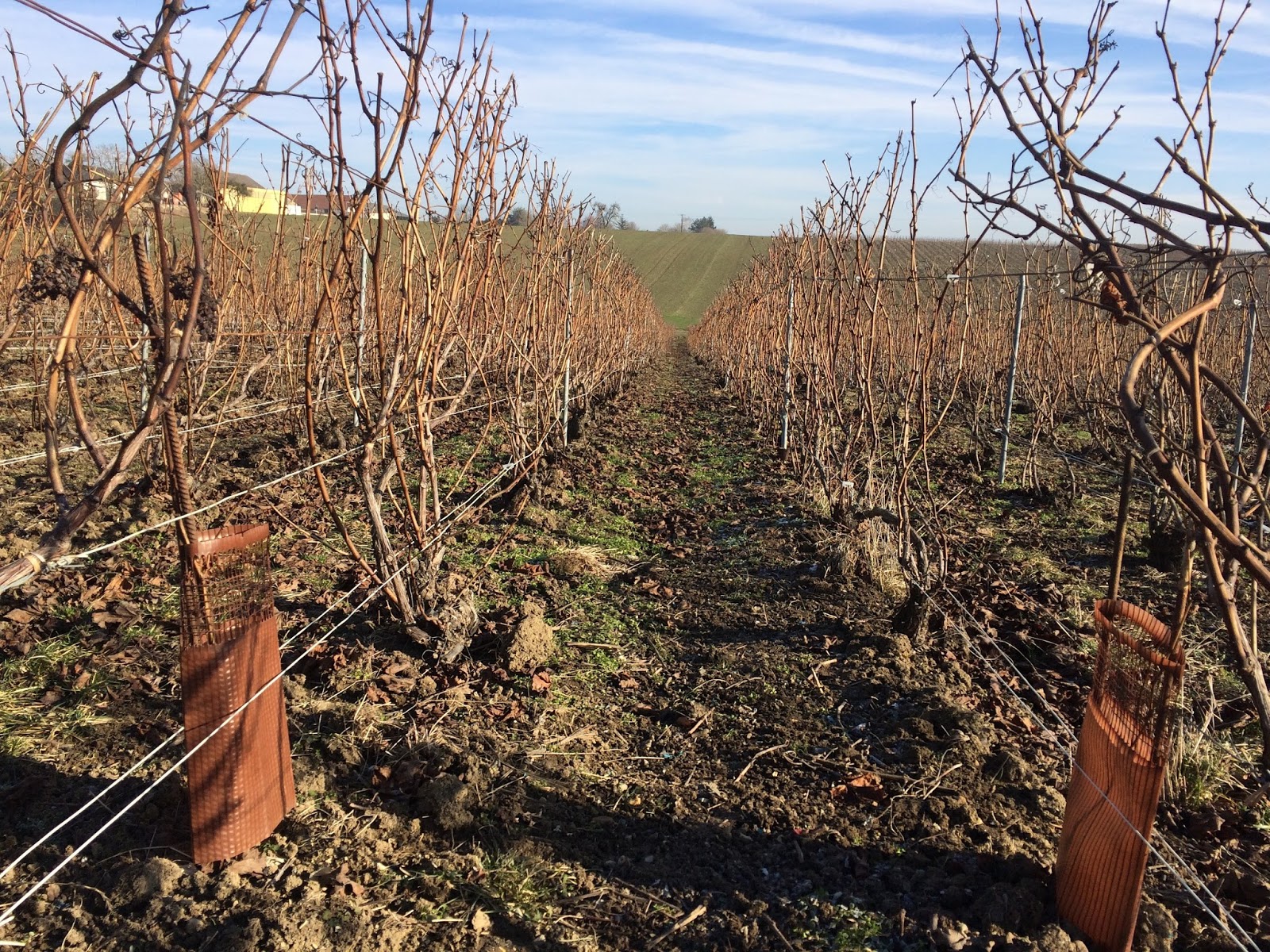
Terroir : les Crochettes

The plot of les Crochettes is situated in the commune of Soulieres, just below the village.

This lieu-dit is cultivated by several different winegrowers. Our part of it comprises 0,4 hectares.

The outline
The plot is situated on a smooth slope that faces the east.

The vines are planted between 1963 and 1967. The orientation is east-west to benefit maximum from the sun.

The porte-greffe (the bottom part of the plant)is 41B.

The rows are about 100 meters long, we cultivate 42.

Particular of this plot is, that the first 10 meters of each row is planted with Pinot Noir or Pinot Meunier whereas the rest is Chardonnay. The philosophy is that the first 10 meters, the lower part, is at higher risk to freeze in spring. Since the Pinots burst a few days after the Chardonays, this was seen as a protection against frost damages, likely to happen in this part of the plot.

The composition
The plot has a composition as follows :(in the upper 25 cm):
  • Clay soil: 31,1 %
  • Silt, fine: 31,6 %
  • Silt, coarse : 16,8 %
  • Sand (gravel?), fine: 8,0 %
  • Sand, (gravel?) coarse: 12,5 %
The maintenance
In the period of growth, we keep the plot free from the worst weeds like bindingweed.

This is done manually by working the soils with the tractor. At times with manual tools as well.

We always plough between the vines.

Between the rows, we either plough or sow grass which is mown throughout the season, approximately from May to September (time of grapeharvest).

The rest of the year, we leave the weeds alone.

Terroir : les Belles Feuilles

The plot of les Belles Feuilles is situated in the commune of Soulieres, between the villages of Givry-les-Loisy and Soulieres.

We share this lieu-dit with several different winegrowers. Our part of it comprises 0,40 hectares.

The outline
The plot consists of two parts. The upper part spreads on a saddle shaped small hill, whereas the lower part gently descends towards the plain of agricultural fields. The orientation is east.

The vineyard is planted between 1968 and 1969. The orientation is east-west to benefit maximum from the sun.

The rows of the upper part are 100 meters long, wheras those in the low end reach 60 meters. We cultivate a total of 25 rows.

The Belles Feuilles plot is planted with both Chardonnays and Pinot Meuniers, about half of each.

The porte-greffe (the bottom part of the plant)is 41B.

The composition
The top layer of the soil (the upper 25 cm) has a composition as follows:
  • Clay soil: 29,8 %
  • Silt, fine: 34,5 %
  • Silt, coarse : 14,2 %
  • Sand (gravel?), fine: 7,5 %
  • Sand, (gravel?) coarse: 14,0 %


Maintenance
In the period of growth, we keep the plot free from the worst weeds like bindingweed.

This is done manually by working the soils with the tractor. At times with manual tools as well.

We always plough between the vines.

Between the rows, we either plough or let natural grass grow which is mown throughout the season, approximately from May to September (time of grapeharvest).

The rest of the year, we leave the weeds.

28. sep. 2009

Our terroirs in Champagne

 
Posted by Picasa
The vineyards of Champagne are small, these are situated between the villages Soulieres and Givry-les-Loisy.

The vineyards of Champagne are small. With an average size of just 12 ares or the equivalent of 1200 square meters, these vineyards are in fact the smallest average in France. Each time they are passed on from one generation of winegrowers to the next, they become even smaller. Ours are no exception.

Alain and his two sisters own three hectares of mainly Chardonnay- and Pinot Meunier-grapes and a little bit of Pinot Noir on top. These vines have all been planted from the beginning of the 1960’es and into the 1980’es which gives them an age between 30 and 50 years. Considerable in Champagne where the average is 35 years. Our vines however still supply a sufficient amount of high quality grapes.

Our plots are situated in three different places in the communes of Souliéres and Givry-les-Loisy and Loisy-en-Brie just outside the Côte des Blancs-region near another terroir known as the Val du Petit Morin.

The plots are Les Crochettes, Belles Feuilles and Vieilles Grandmeres.

They are all placed on the côte above Vertus. This slope follows a north-south and later an east-west direction in a height of 250 meters above the sea. At its feet the farmed land of a vast plain begins, the Champagne Crayeuse.

All the vineyards will eventually be replanted in the next decades as we will take over the daily work in the last two hectares that currently are explored by a cousin. This will also be the opportunity to analyse the contents of the soils in order to decide if and where we can do our own single plot champagne.

 
Posted by Picasa
The view from the plots of the Vieilles Grandmeres towards the flat Champagne Crayeuse.

Vieilles Grandmeres

 
Posted by Picasa
The plot - lieu-dit - of Vieilles Grandmeres is situated five kilometres further south on the other side of the village of Loisy-en-Brie. As for the old name of the fields we can all just wonder about the origins of it.

These vineyards are placed on slopes that almost form a shape of a semi-bowl facing southeast.

They have gradually been planted by Alain’s mother and cousin between the 70’s and the 80’s. One half is planted with Chardonnay and the other half with Pinot Meunier-grapes.

The topsoil is clayey in the upper part of these vineyards. Less than a metre deeper begins the layer of typical Champagne chalk that supplies the wines with the mineral touch, so special for this region. It radiates the warmth of the sun and it diverts the water as well.

These richer soils have a tendency to give a stronger growth of the plants. We therefore have to prune harder in the winter and remove surplus buds, branches and even grapes in spring and summer to ensure a perfect early maturation of the remaining grapes.

You will find this vineyard just outside the Côtes des Blancs-region in a terroir known as the Val du Petit Morin on the slope - côte - above Vertus in a height of 250 meters above the sea. At its feet the farmed land of a vast plain begins, the Champagne Crayeuse.

 
Posted by Picasa
 
Posted by Picasa
Photos: The grapeharvest of 2011

Belles Feuilles

 
Posted by Picasa
The plot - lieu-dit - of Belles Feuilles is situated between the communes of Soulieres and Givry-les-Loisy.

This plot covers both sides of a soft slope that faces east and thus it gets a maximum amount of sun from the early morning until sunset.

It is orientated east-west and thus gets a maximum amount of sun from the early morning until the sun sets. The chalk is not far from the surface, which drains the land the way vines like it.

Our part of it is planted with Pinot Meunier and Chardonnay by Alain's grandfather in the late 1960'ies.

Despite their considerable age these vines produce grapes of a very good quality. This vineyard naturally produces just enough branches and leaves for the vines and grapes to grow and still see a maximum of the sun.

The grapes usually reach a deep black colour that make them very suitable for the local red wine for the Rosé d’Assemblage as well as for the Rosé de Saignée champagne which receives its deep colour from the skin of black grapes like those of the Belles Feuilles-plot.

You will find this vineyard just outside the Côtes des Blancs-region in a terroir known as the Val du Petit Morin on the slope - côte - above Vertus in a height of 250 meters above the sea. At its feet the farmed land of a vast plain begins, the Champagne Crayeuse.

 
Posted by Picasa
 
Posted by Picasa
Summer, winter and grapeharvest in the Belles Feuilles-plot.

Les Crochettes

 
Posted by Picasa
Grapeharvest 2009 in Les Crochettes, Soulieres.

The plot - lieu-dit - of Les Crochettes is situated in the commune of Soulieres just below the village itself and only about 100 metres away from the farm.

It is on a smooth slope facing east where the chalk is more than one meter away from the surface in its lower part.

 
Posted by Picasa
Alain’s grandfather has planted it with Chardonnay and a little bit of Pinot Noir at the beginning of the 1960’ies.

It may get the morning dew of the autumn as well as the potentially dangerous frost of spring, which is why the low part is planted with the late Pinot Noir-grapes rather than the early Chardonnay-grapes.

You will find this vineyard just outside the Côtes des Blancs-region in a terroir known as the Val du Petit Morin on the slope - côte - above Vertus in a height of 250 meters above the sea. At its feet the farmed land of a vast plain begins, the Champagne Crayeuse.

 
Posted by Picasa

1. okt. 2008

The AOP-system

Champagne is an AOP. An Appellation d'Origine Protegée. A product that is produced according to a number of strictly defined rules to ensure a high quality.

Amongst these are:

  • 1) We follow detailed instructions on how to deal with the vineyards.
  • 2) We harvest all grapes manually.
  • 3) We only use grapes from Champagne to make champagne.
  • 4) We never bottle the new wines until the year after the grapeharvest.
  • 5) Non vintage champagne mature at least 15 months in the bottle.
  • 6) Vintage champagnes mature at least 36 months in the bottle.

    The AOP-label guarantees that the wine has been made according to these rules. However you will find the AOP mentioned. The word champagne in itself is acknowledged as the AOP.

    Champagne has been an AOP since August 1st 2009, where the new AOP-system joined the French AOC-system on a European level. Champagned joined the AOC-system in 1935. Seven years after it in 1927 had introduced the délimitation: The strictly defined geographical area, where grapes for champagne can be grown.

    Other high quality wines, cheeses and meats of France are AOP's as well. Just think about Burgundy red wines, camembert cheeses and chicken from Bresse or ham from Bayonne.
  • 26. aug. 2000

    Les vendanges 2011

     
    Posted by Picasa

    Les vendanges chez nous commencent Saturday 27 aout pendant environ huit jours.

    Nous allons vendanger 1,5 hectares de noirs: Pinot Meunier et Pinot Noir et 1,5 hectares de blancs: Chardonnay.

     
    Posted by Picasa

    Environ 20 personnes habitent, mangent et travaillent ensemble pendant cette periode. 12 pour la cuillette, 3 pour vider les seaus, 1 chauffeur, 2 chefs, Alain et Solveig et des amis ou famille, qui donne un main quelques heures ou la journée parce que faire les vendanges devient aussi un facon de vivre.

     
    Posted by Picasa
    Les images sont de la vendange en 2010.

    Si vous etes curieux de voir des grappes de 2011. Voilà:

    Des lourdes et belles Pinot Noirs suivi par des Chardonnays.

    Vous avez raison: Ils ne sont pas tous belles comme ca. Mais les pires on laisse par terre. Alors, nous preferons de vous montrer les raisons sains que nous allons chasser pour remplir nos paniers pendant la semaine prochaine.

     
    Posted by Picasa
     
    Posted by Picasa
    Les raisins du champagne: Pinot Noir et Chardonnay, 20 aout 2011.

    Grapeharvest 2011

     
    Posted by Picasa
    We have finished our grapeharvest in about seven days.

    1,5 hectares of red Pinot Meunier and Pinot Noir grapes and 1,5 hectares of the white Chardonnay-grapes have been fully harvested, which adds up in about 40 tonnes of grapes.

    All dealt with manually by a team of family, friends and occasional French and Danish staff that has worked and lived together partly or fully during the period.

     
    Posted by Picasa
     
    Posted by Picasa
    Especially the Chardonnay-grapes were of very good and healthy quality as we delivered them to the presses.

    The Pinot Noir and Pinot Meunier grapes had more rots and therefore we had to leave 20-25 percent of them on the floor to deliver the rest in the sought-after quality.

     
    Posted by Picasa
     
    Posted by Picasa
    These weeks the musts of the newly pressed grapes fermentate into a young wines.

    However, these will not stable in the first months, so only after the Christmas and New Years festivities will we begin to taste them more systematically to decide how we want to blend the assemblages of 2011.